A dictionary* will tell you that the word "tessellate" means to form or arrange small squares in a checkered or mosaic pattern. The word "tessellate" is derived from the Ionic version of the Greek word "tesseres," which in English means "four." The first tilings were made from square tiles.
A regular polygon has 3 or 4 or 5 or more sides and angles, all equal. A regular tessellation means a tessellation made up of congruent regular polygons. [Remember: Regular means that the sides and angles of the polygon are all equivalent (i.e., the polygon is both equiangular and equilateral). Congruent means that the polygons that you put together are all the same size and shape.]
Example of regular tessellation :
| a tessellation of triangles |  |
| a tessellation of squares |  |
| a tessellation of hexagons |  |
There are also eight semi-regular tessellations which consist of two or more regular polygons which meet at each vertex and also do not overlap or leave gaps.

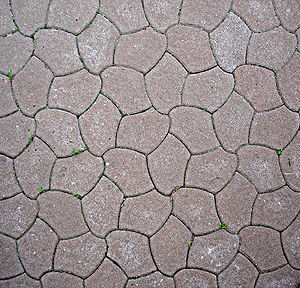
There are an infinite number of tessellations which are made up of irregular shapes; these are known as non-regular tessellations.

On 3D surfaces such as the hyperbolic plane, spheres and tori, there are an infinite number of regular tessellations. For example, on the surface of a sphere, a pentagon can tessellate regularly. (The diagram above is shown as a disk on the Euclidean Plane, which leads to distortions.)
Tessellations in Art

A Roman mosaic from Fishbourne Palace, England
One of the greatest practitioners of the use of tessellations in art was the Dutch graphic artist M. C. Escher (1898-1972). Although he is more famous for his drawings of the impossible, he also worked extensively on tessellations. Many of his works using tessellations consist not of a single repeated image, but of a smooth metamorphosing of one image into another. His 1938 lithograph, Sky and Water 1 (bottom right) is typical of his work. Since he started the trend many other artists have made similar tessellating art (bottom centre).

Sun and Moon by M. C. Escher

A tessellation of frogs on a sphere in the style of Escher

Sky and Water by M. C. Escher
Example of Tessellation in daily life :


0 komentar:
Posting Komentar